
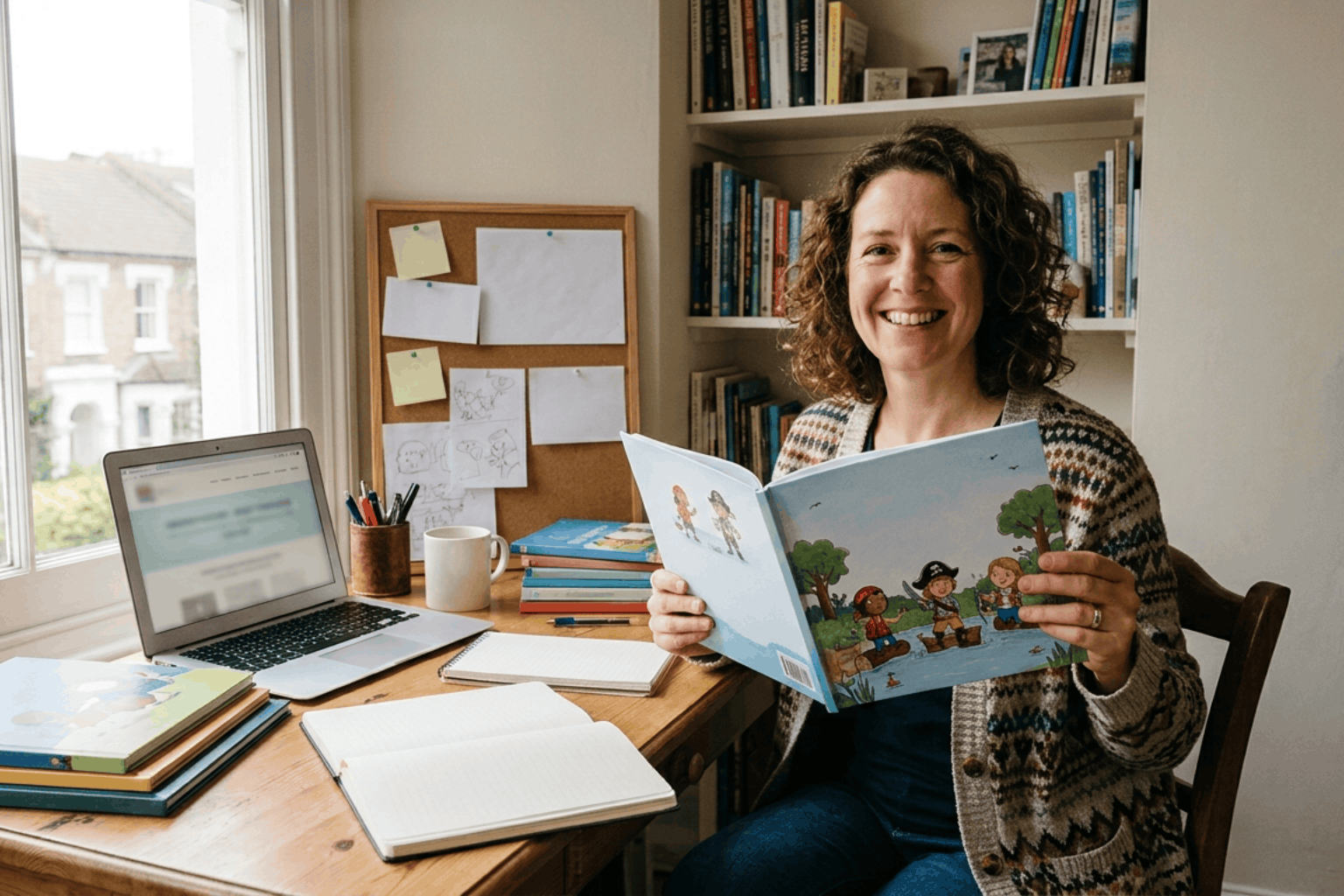
To publish a children’s book in the UK, write a story that suits your young reader’s age and word count, edit it, commission professional illustrations, design and format the book, get an ISBN, publish in print and eBook, and market it to parents, teachers and libraries.
This guide from Frontline Publishing UK, the UK branch of New York-based Frontline Publishing, walks you through each step of children’s book publishing, from first draft to finished copy.
How Long Should a Children’s Book Be?
Length depends on the reader’s age. These typical word counts are a guide:
| Book type | Typical age | Word count |
| Picture book | 3 to 7 | 400 to 800 words (aim for about 500) |
| Early reader | 5 to 8 | 1,000 to 2,500 words |
| Chapter book | 7 to 9 | 5,000 to 15,000 words |
| Middle grade | 8 to 12 | 20,000 to 55,000 words |
Most picture books run to 32 pages, which is 16 double-page spreads. Because printers work in sets of pages, a book with 30 pages usually costs the same as one with 32, so plan to use them all.
What Makes a Good Children’s Book?
The best children’s books share a few qualities. They have a clear, lovable main character, a simple problem to solve, and a satisfying ending. They use repetition, rhyme or a memorable pattern that children enjoy joining in with, plus a warm touch of humour. The language suits the age group, with words that are fun to say aloud, and the message is woven into the story instead of lectured. Test yours by reading it to a child and noticing when they lose interest.
Step 1: Know Your Reader and Your Buyer
Children read the book, but parents, grandparents, teachers and librarians buy it. Choose a clear age group, then write a story with a theme adults value, such as kindness, bedtime, friendship or learning. Look at successful books in your category to understand length, tone and price, and note what makes them feel fresh.
Step 2: Write and Edit for Reading Aloud
Picture books are read aloud, so rhythm, repetition and simple, vivid language matter. Leave room for the illustrations to tell part of the story, and avoid describing what the pictures will show. Professional editing helps you cut every unnecessary word, and our book editing team understands how children’s writing differs from adult writing.
Step 3: Plan Your Page Layout
Map the story across your 32 pages. Allow about three to six pages for the title page, copyright information and other front and back matter, then divide the story into page turns that build suspense. A storyboard, which is a rough sketch of every spread, saves expensive changes later.
Step 4: Commission Professional Illustrations
Illustrations carry much of a children’s book’s appeal. Pick an illustrator whose style suits your age group, and ask for character sketches before the final art. Agree in writing who owns the illustrations and how you can use them. Frontline Publishing UK’s children’s book team can guide you through illustration and layout.
Step 5: Design the Cover and Format the Book
A bright, clear cover sells a children’s book, and it must look good as a small thumbnail online. Illustrations also need to be high resolution for printing. Our book cover design and book formatting services prepare your files for print and eBook.
Step 6: Get an ISBN and Publish
Each format needs an ISBN, then you choose print, eBook or both. Full-colour printing costs more than black and white, so it affects your price. Hardbacks make good gifts, while paperbacks keep prices lower. Our guides to publishing a book in the UK and publishing on Amazon KDP explain the options, and our children’s book publishing services can manage the process for you.
Step 7: Market to Parents, Teachers and Libraries
Children’s books sell through personal recommendation. Offer readings at schools and libraries, collect reviews, and share behind-the-scenes illustrations on social media. Ask your illustrator to share the artwork too, because it introduces your book to their followers. A simple author website gives parents and teachers one place to find your book, and our book marketing team can plan your launch.
How Much Does It Cost to Publish a Children’s Book?
Illustration is usually the largest cost, followed by editing, cover design, formatting and printing. Full-colour printing costs more than black and white, and hardbacks cost more than paperbacks. Because every book differs in length, artwork and format, prices vary widely, so compare quotes on the same scope. Frontline Publishing UK gives you a clear quote after a free consultation.
Traditional Publishing or Self-Publishing for Children’s Books?
In traditional publishing, a picture book text is usually matched with an illustrator chosen by the publisher, and you have little say over the artwork. Self-publishing lets you choose your illustrator, style and timeline, and you keep control of your book, although you manage or pay for each stage.
Common Children’s Book Mistakes
- Writing too many words for a picture book.
- Describing the pictures instead of letting them tell the story.
- Using low-resolution images that print blurry.
- Skipping a written agreement with the illustrator.
- Choosing a cover that looks cluttered in thumbnail size.