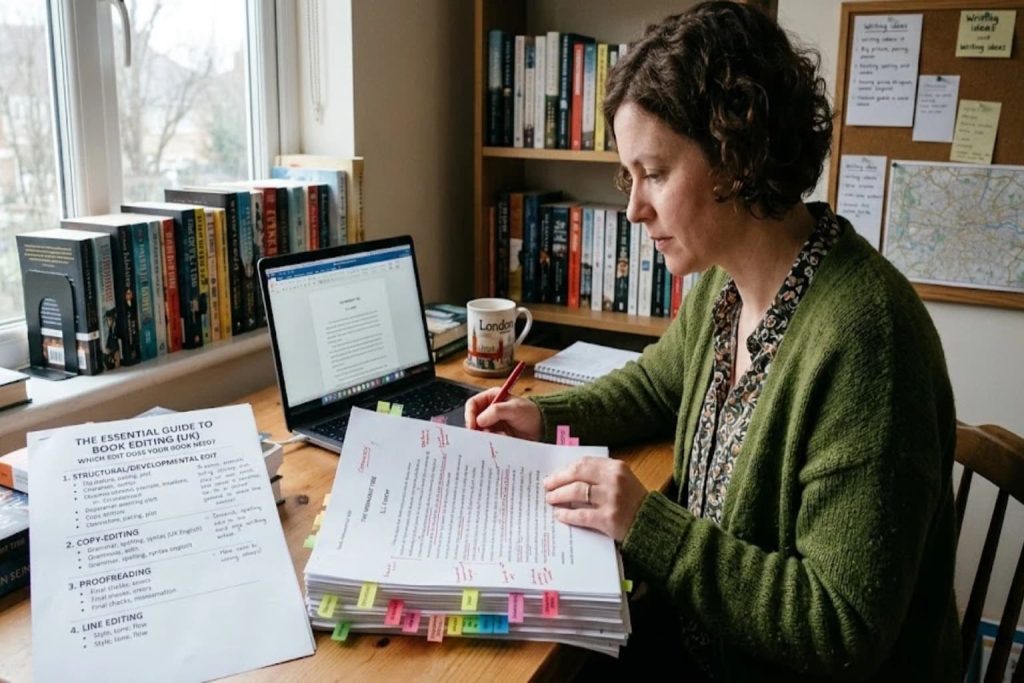

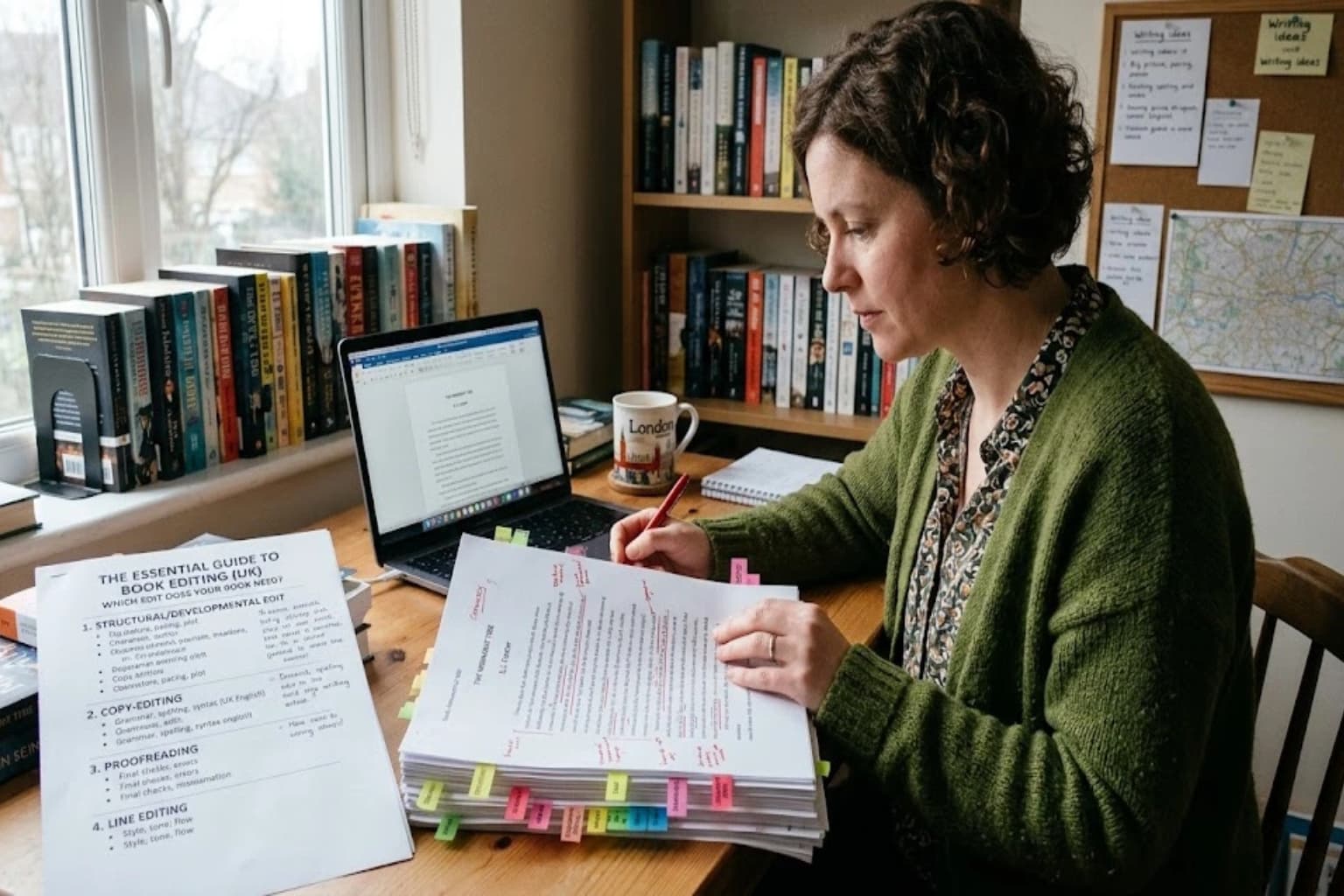
There are four main types of book editing: developmental (structural) editing, line editing, copyediting and proofreading. Developmental editing fixes the big picture, line editing polishes style, copyediting corrects grammar and consistency, and proofreading is the final check for typos. Most books need them in that order.
This guide from Frontline Publishing UK, the UK branch of New York-based Frontline Publishing, explains what each type does, what editing costs in the UK, and how to choose the right one.
The Four Types of Book Editing at a Glance
| Type | What it fixes | When it happens |
| Developmental editing | Structure, plot, pacing, argument | After your draft |
| Line editing | Style, tone, flow | After structural changes |
| Copyediting | Grammar, spelling, consistency | Once the text is settled |
| Proofreading | Remaining typos and layout errors | After formatting |
What Is Developmental Editing?
Developmental editing, also called structural editing, looks at the big picture. For fiction, an editor checks plot, pacing, characters and setting. For nonfiction, they check structure, logic and whether chapters are missing or out of order. You usually receive an editorial letter with detailed feedback. For a memoir, this might mean choosing which events to include; for a business book, it might mean sharpening your central message. Do this first, because it may involve rewriting, and there is no point polishing sentences you may cut.
What Is Line Editing?
Line editing works at sentence level. The editor improves rhythm, clarity, word choice and tone so the text reads smoothly and sounds like you. Think of it as improving how the book sounds, not only whether it is correct. Some editors combine line editing with copyediting, so always ask what a quote includes.
What Is Copyediting?
Copyediting corrects grammar, spelling and punctuation, and checks consistency in names, dates, spellings and style. A good copyeditor also flags factual errors for you to resolve. For a UK readership, it is worth agreeing British spelling and a style guide at the start.
What Is Proofreading?
Proofreading is the final check, done after your book has been typeset. It catches typos, layout slips and errors introduced during formatting. It involves fewer changes than copyediting, so it is not a substitute for it. Our book proofreading services give your manuscript a last careful read before publication.
Which Type of Editing Does Your Book Need?
- Early draft with structural doubts: start with developmental editing.
- Sound structure but rough prose: line editing and copyediting.
- Polished and self-edited manuscript: copyediting and proofreading.
- Formatted proof ready to print:
Most first-time authors benefit from at least a copyedit and a proofread. If you are unsure, ask an editor to assess a sample chapter and recommend the right level of edit. If you are still drafting, start with our step-by-step guide to writing a book. Frontline Publishing UK offers book editing services at every stage.
How Much Does Book Editing Cost in the UK?
UK editors charge by the hour, by the word or by the project. The Chartered Institute of Editing and Proofreading (CIEP) publishes suggested minimum hourly rates for 2026 to 2027: £31.92 for proofreading, £37.11 for copyediting and £42.66 for development editing. These are minimums, not quotes. Experienced editors often charge more, and the final price depends on length, the condition of the text, the deadline and the editor’s specialism. Compare quotes on the same scope and word count, and ask for a clear price after a free consultation. Frontline Publishing UK keeps its pricing transparent, so you know what you will pay before work begins.
What Happens During a Professional Edit?
The process usually starts with an assessment of your manuscript, so the editor can agree the scope with you. The editor then works through the text, typically using tracked changes and comments in Word. You review each suggestion, accept or reject it, and answer any queries. Finally, you receive a clean, finished version. Because you make the final decisions, the book stays yours and keeps your voice.
Common Book Editing Mistakes to Avoid
- Proofreading before the book has been formatted.
- Polishing sentences before the structure is settled.
- Asking for “editing” without saying which type.
- Relying on friends or family for a professional edit.
- Skipping a written agreement on scope and deadlines.
How to Choose a Book Editor
- Ask exactly which type of editing is included.
- Request a sample edit of a few pages.
- Look for experience in your genre.
- Agree British or American spelling in advance.
- Confirm the timeline and the number of revision rounds.
- Make sure the editor protects your voice.
Why Not Just Edit Your Own Book?
You know what you meant to say, so your brain fills gaps and skips errors on the page. A professional editor sees the manuscript as a new reader would. Editing is also the stage that most separates a polished book from one that feels amateur, which matters when readers decide in a few pages whether to continue.
Ready to polish your manuscript? Talk to Frontline Publishing UK about book editing. Once it is edited, our team can handle book formatting and book publishing.
Book Editing FAQs
What is the difference between copyediting and proofreading? Copyediting improves grammar, consistency and clarity and may change many things on each page. Proofreading is a final check for leftover typos and layout errors after formatting.
Do I need developmental editing? If your plot, structure or argument is still uncertain, yes. If your manuscript is structurally sound, copyediting and proofreading may be enough.
How long does book editing take? It depends on length, the type of edit and the editor’s schedule, so ask for a timeline before you book.
Can I skip editing if I self-publish? You can, but unedited books tend to attract poor reviews, so professional editing is one of the best investments you can make.
What is the correct order of editing? Start with developmental editing, then line editing, then copyediting, and finish with proofreading once the book has been formatted.
Does Frontline Publishing UK offer book editing? Yes. Frontline Publishing UK offers editing and proofreading for memoirs, business books, children’s books and fiction.